
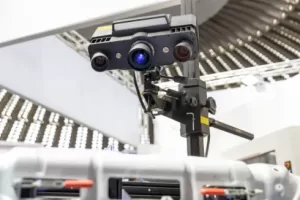
As 4K and 5K industrial cameras gain traction in automated inspection, folks often run into issues like poor resolution, blurry edges, and high distortion when picking lenses. This article dives into how 8mm lenses perform with 5K cameras, spotlighting key specs to guide better choices.
Why 8mm Machine Vision Lenses Are Ideal for 5K Cameras
8mm focal length strikes a nice balance between wide angle views and solid image coverage. It fits well with common sensor sizes like 2/3-inch or 1/1.8-inch. With an 8mm focal length and 20MP optical resolution, this configuration offers a balanced field of view and exceptional clarity for 5K industrial cameras.
This setup gives a decent working distance and depth of field, which matters in tight industrial spaces. Think about conveyor belts or robotic arms – you need that flexibility without sacrificing detail.
Plus, 2/3″ 8mm 20mp 5K m12 mount compact machine vision board lens handle the high pixel count of 5K sensors, around 20 megapixels, keeping things sharp across the frame.
Key Factors When Selecting an 8mm Machine Vision Lens
Picking the right lens boils down to a few essentials. Let’s break them down.
1. Resolution and Sensor Format Compatibility
Match the lens resolution to the camera’s needs. For 5K, that’s about 20 megapixels, so aim for lenses with at least 200 line pairs per millimeter. Sensor size plays a big role too – a 2/3-inch sensor has roughly an 11mm diagonal image circle. The lens must cover that fully to avoid vignetting.
Lenses supporting a 2/3″ format (Φ11 mm image circle) fully cover 5K sensors without vignetting, ensuring edge to edge sharpness.
AICO’s ACHF080402320MP lenses are designed to fully illuminate 2/3-inch sensors, maintaining 20MP level sharpness from center to edge.
Sometimes people skip checking this, but it can lead to uneven images that mess up inspections.
2. Mount Type and Integration Flexibility
Mounts vary: M12 for compact modules versus C-mount for standard industrial cameras. M12 suits mini board lenses in embedded systems, keeping things small and light.
C-mount offers more versatility for larger setups. Consider space constraints – cramped machines favor M12 machine vision lenses. Integration ease can make or break a project, especially in retrofits.
3. Distortion and Edge Clarity
Distortion affects measurement accuracy in detection tasks. Keep it under 5% for reliable geometry. Relative illumination above 60% ensures even brightness, vital for automated optical inspection and precise measurements.
A well designed optical layout achieving less than 5% distortion and over 60% relative illumination keeps image geometry accurate—essential for AOI and measurement.
With distortion under 3%, AICO lenses ensure dimensional accuracy crucial for AOI and robotic vision applications.
Edge clarity drops off in cheaper lenses, but high end ones hold up.
4. Light Transmission and F-Number
F4.0 aperture balances depth of field and exposure. It works for high speed industrial lighting and 5K sensor demands. Multi-layer coatings boost transmission, cutting glare and boosting contrast.
A fixed F4.0 iris balances depth of field and light uniformity, ideal for stable exposure under machine vision lighting. Each AICO lens uses multi-layer coating to achieve high transmission at F4.0, ensuring consistent brightness for 5K sensors.
Low light transmission can force slower shutter speeds, risking blur in fast moving lines.
Comparison: 8mm Lens Options for Industrial Applications
Different apps call for tailored specs. Here’s a quick rundown:
- PCB Inspection: Low distortion, fixed iris. Offers stable focus accuracy.
- Robotics Vision: Compact housing, M12 mount. Lightweight design fits moving parts.
- AOI / Measurement: 20MP, high MTF. Delivers subpixel precision.
Field tests show that AICO 8mm lenses consistently outperform generic models in edge contrast and uniformity. Generic lenses might save cash upfront, but they often falter in tough environments. High MTF options shine for detailed work.
Take PCB checks – low distortion prevents false positives on tiny components. In robotics, compact mounts avoid adding bulk, which could throw off balance. For AOI, that subpixel edge makes all the difference in spotting defects early.
Typical Use Cases of 8mm 5K Lenses
These lenses pop up in smart manufacturing for PCB detection and solder joint recognition. Spot flaws before they cascade. Automated inspection handles defect detection and OCR reading with ease. High res catches subtle issues.
Robotic vision uses them for positioning and grasping objects accurately. Even medical devices and bio-imaging systems benefit from the clarity in controlled settings.
From industrial inspection to embedded AI vision, AICO lenses deliver clarity and repeatability under diverse lighting conditions. One quirky thing: in bio-imaging, folks sometimes adapt these for lab automation, tweaking setups for sterile environments.
They hold up in dusty factories too, where reliability counts.
How to Choose the Right Lens for Your 5K System
Follow these steps to nail it:
- Confirm sensor size and resolution. Match the lens to avoid mismatches.
- Determine installation space and interface. M12 or C-mount?
- Assess distortion, illumination, and focal length. Test for your lighting.
- Verify imaging performance in real applications. Prototypes help.
Skipping tests might seem fine at first, but real-world vibes differ from specs.
Budget for samples if possible – it pays off.
Final Thoughts: Precision Optics for Modern Machine Vision
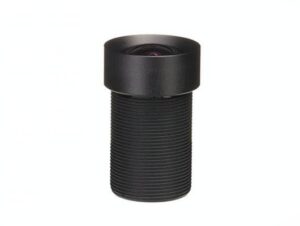
8.0mm 2/3 inch F4 5K m12*0.5mm mini industrial fixed lenses make a solid pick for 5K industrial imaging. They blend coverage, sharpness, and ease.
Focus on imaging consistency and sturdy mechanical design for long-term wins. In the end, the right lens boosts efficiency, cutting downtime and errors.
Need guidance on selecting the right lens for your 5K camera?
Talk to the optics experts at AICO for tailored recommendations.
FAQ
Q: How to select lenses for machine vision?
Just check 4 things: Sensor size (lens image circle must cover it); Resolution (5K camera needs 20MP+ lens); Focal length (match your field of view); Distortion (<3% for measurement, <5% is fine for basic detection) Always test the real combo. Specs can lie.
Q: Is 5K always better than 4K?
Nope. 4K is faster, cheaper, and enough for most lines. Only go 5K if you need to see tiny defects or cover a huge area with the same detail.
Q: Are there 5K cameras?
Yep, tons. 20MP industrial cameras are called “5K.”
Q: Are there 10K cameras?
Yes, but crazy expensive. Used for flat panels, printing, solar cells. Normal people never need them.
Golden rule: pick the cheapest resolution that lets your smallest defect show up as 3–5 pixels. More is usually just wasting money and speed.