
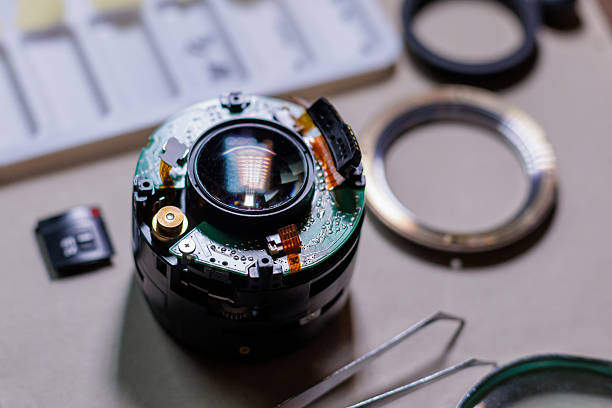
Understanding the fundamentals of machine vision lenses is essential for anyone working in industrial imaging or automation. The short answer to what makes them so critical lies in precision — a well chosen lens defines how accurately a system captures, interprets, and processes visual data. Every pixel counts, and every optical parameter matters.
Understanding Machine Vision Lenses
Machine vision lenses serve as the eyes of automated imaging systems. Their optical quality determines whether a camera can detect minute defects, measure dimensions, or guide robotic movement with accuracy.
The Role of Machine Vision Lenses in Imaging Systems
Lenses are a critical component in an imaging system. The right lens is needed to maximize the camera and board level imaging device’s capabilities. Without the correct lens, image quality may be compromised. In other words, even the most advanced sensor cannot perform well if paired with an unsuitable lens.
Key Fundamentals of Machine Vision Lenses
Before exploring specific types, it’s worth understanding three foundational optical parameters that define performance: distortion, resolution, and contrast.
Distortion in Machine Vision Lenses
Distortion changes how straight lines show up in a picture. Two usual kinds are barrel distortion, where lines bend outward, and pincushion distortion, where lines bend inward.
Pick a machine vision lens with two types of distortion in mind: radial distortion and perspective distortion. Radial distortion comes from uneven magnification over the image area. Perspective distortion, or parallax, happens when things farther away look too small because of the angle of view.
To cut these issues, makers often pick telecentric lenses. They keep steady magnification over depth. This helps with size accuracy. It’s crucial for measuring or checking jobs where shapes must stay true to size.
Resolution and Its Importance
Resolution defines how finely a lens can reproduce object detail. Resolution measures the machine vision system’s ability to reproduce object detail. As pixel sizes on sensors shrink, lenses must resolve higher spatial frequencies to match sensor capability.
For instance:
| Camera Pixel Size | Pixel Limited Resolution (lp/mm) | Lens Requirement |
| 3.45 μm | 145 lp/mm | ≥145 lp/mm |
| 2.4 μm | 208 lp/mm | ≥208 lp/mm |
If a lens cannot meet this threshold, fine details blur together — reducing measurement precision or defect detection accuracy.
Types of Machine Vision Lenses
Different tasks demand different optical geometries — from capturing wide scenes to zooming into intricate components.
Wide Angle Machine Vision Lenses
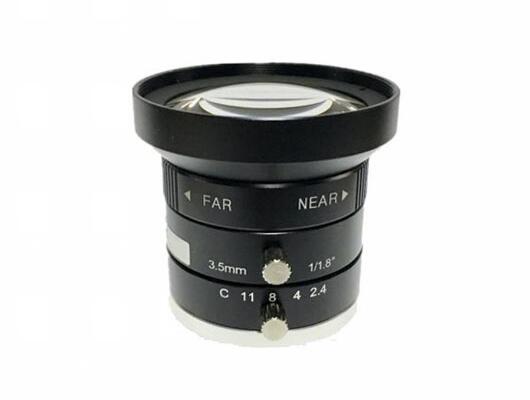
Wide angle lenses provide broad fields of view for close range monitoring or inspection over large areas. They are often used where space is limited but situational awareness is vital. For example, AICO’s ACKHF03524MMP wide angle model features an F2.4 aperture and 105° diagonal field of view — ideal for compact machine setups requiring high coverage with minimal curvature error.
Advantages include:
- Large coverage area with short working distance
- Useful for conveyor or assembly line monitoring
- Compact form factors
However, such designs can introduce more radial distortion or uneven illumination toward edges — challenges mitigated through precision glass elements or digital correction algorithms.
Machine Vision Zoom Lenses
Zoom lenses allow variable focal lengths without changing position — perfect for flexible inspection ranges or multi-size product lines. As noted in technical classifications, zoom lenses are broadly classified into manual zoom lenses and automatic zoom lenses. Zoom lenses, because they allow the focal length to change within a certain range within a single lens element, can magnify or reduce the size of the monitored target.
This flexibility supports dynamic focus control during operation — beneficial in packaging inspection or robotic sorting where object distances vary continuously.
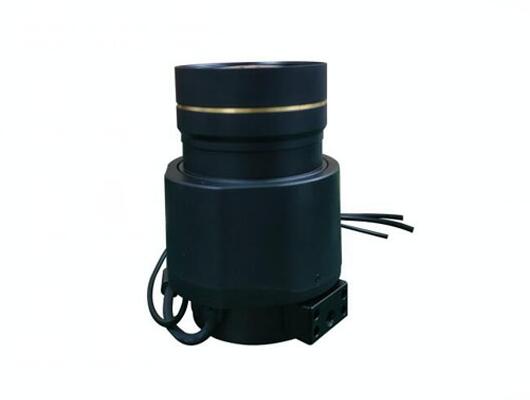
Common zoom ratios include 6× (6–36 mm) or 10× (8–80 mm), balancing magnification power with optical stability. e.g. AICO’s 1.1″ P-Iris 12mp 4K C mount motorized focus zoom lens
Selecting the Right Lens for Your Needs
Choosing the best machine vision lens isn’t only about specifications; it’s about aligning optical behavior with real world conditions.
Factors to Consider When Choosing a Lens
Engineers should evaluate:
- Application type– measurement vs detection vs recognition
- Sensor compatibility– match image circle size to sensor format
- Lighting conditions– fixed vs auto iris depending on brightness variability
- Environmental constraints– vibration resistance, temperature tolerance
- Budgetperformance trade offs – higher resolution often means higher cost
The choice of lens is important for both system quality and project cost. In essence, proper selection ensures both performance efficiency and cost effectiveness across industrial deployments.
Advances in Machine Vision Lens Technology
Future developments point toward hybrid electro-optical systems capable of real time focus adjustment using embedded actuators — merging optics with smart control electronics for adaptive imaging environments.
Machine vision lenses might seem like small components within complex automation systems, but their influence extends far beyond basic imaging—they define what machines can truly “see.”
Ready to Choose the Right Machine Vision Lens for Your Application?
AICO, a professional manufacturer specializing in industrial and professional optical products, designs lenses for uses from security and automotive systems to advanced machine vision. Their engineering style stresses how optical design affects image clearness. This is something every builder should think about when putting together strong setups.
Contact AICO today to explore our advanced machine vision lenses.
FAQs
Q: What does F-number mean on a machine vision lens?
It represents the ratio between focal length and aperture diameter; smaller F values allow more light but reduce depth of field.
Q: How do I know if my lens matches my camera sensor?
Ensure the image circle covers your sensor format (e.g., 1/2″ lens for 1/2″ sensor).
Q: Why does my wide angle image look curved?
That’s barrel distortion caused by radial magnification differences; software correction can minimize it.
Q: Are zoom lenses suitable for high speed inspection?
Yes—if they maintain stable focus during focal changes; mechanical quality is key here.
Q: What role does MTF play when comparing lenses?
MTF indicates how well a lens maintains contrast at different detail levels—higher MTF usually means sharper images suitable for precise measurement tasks.