

Short wave infrared (SWIR) technology has moved from niche military applications into the heart of the factory floor. It is not just another “night vision” tool; it is a fundamental shift in how we perceive material properties.
Understanding the Short Wave Infrared Spectrum
SWIR refers to the light spectrum typically between 900nm and 2500nm. This is a specific “sweet spot” in the electromagnetic spectrum. Unlike thermal imaging, which detects the heat emitted by an object itself, SWIR light interacts with objects similarly to visible light, involving reflection and absorption. This means you get images with shadows and contrast that look familiar to the human eye, rather than the “glowy” blobs seen in long wave thermal cameras. This spectral range allows for imaging through atmospheric haze, smoke, and certain plastics.
How Does a SWIR Lens Differ from Standard Machine Vision Lenses?
You cannot simply take a standard machine vision lens and slap it onto an InGaAs (Indium Gallium Arsenide) sensor. Specialized glass materials like InGaAs sensors require lenses optimized for non-visible wavelengths. If you use standard glass, the transmission rates drop off a cliff as you move past 1000nm. Furthermore, traditional anti-reflective (AR) coatings fail in the SWIR range; specialized coatings are mandatory for high transmission. Without these, you deal with internal ghosts and massive flare.
Optical designs must account for different refractive indices to ensure sharp focus across the infrared band. A lens that is sharp at 500nm will be completely out of focus at 1500nm because the light bends differently through the glass elements.
Essential Characteristics for Industrial Grade SWIR Optics
Industrial environments are brutal on optics. When integrating a SWIR lens, precision is the only thing that prevents expensive false rejects on a high speed line.
High aperture efficiency is critical for capturing low light infrared signals in high speed inspection. Since SWIR sensors often have lower quantum efficiency than their visible CMOS cousins, the lens needs to “gather” every possible photon. Low distortion parameters ensure measurement accuracy in metrology based machine vision.
If you are measuring the width of a silicon wafer, a 1% distortion error is unacceptable. Finally, ruggedized mechanical construction protects internal elements from vibration in factory environments. We have seen mounts shake loose in automotive plants; a proper industrial lens needs locking screws and a housing that can take a hit.
Why Use SWIR Lenses for Material Identification?
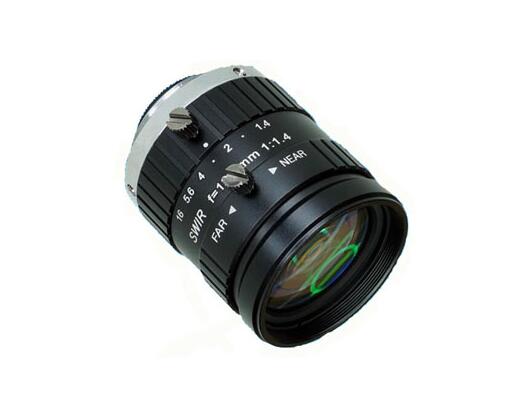
The real power of this technology is the ability to see chemical signatures that are invisible to us. e.g. AICO’s 2/3″ 8.5mm wide angle C mount SWIR lens
Seeing the Invisible: Moisture Detection and Chemical Analysis
Water has a high absorption peak in the SWIR range, making wet areas appear dark or black. This is a game changer for quality control. This contrast allows for precise monitoring of irrigation in agriculture or dryness in industrial coating processes.
Imagine a line of apples passing by; a bruise that is invisible to the eye will have a different moisture content and pop out as a dark spot under a SWIR lens. Chemical composition differences that look identical in visible light become distinct under SWIR wavelengths. For example, different types of white powders—sugar, salt, or pharmaceutical ingredients—can be instantly distinguished by their absorption profiles.
Penetrating Opacity in Packaging and Silicon Inspection
One of the most common uses for a SWIR capable machine vision lens is looking through things that are normally “solid.” SWIR light can pass through silicon wafers, enabling the detection of internal cracks or voids in semiconductor manufacturing. Since silicon is transparent at these wavelengths, you can see right through the brick to the circuits inside. Many opaque plastics used in pharmaceuticals become transparent, allowing for fill level verification without opening the container. Sub-surface defects in composite materials are revealed through deep spectral penetration. It is almost like having X ray vision but without the radiation hazards.
Solving Challenges in High Temperature Environments
In heavy industry, knowing the temperature is not enough; you need to see the shape of the heat.
Can SWIR Lenses Monitor Thermal Uniformity?
While not a replacement for long wave thermal cameras, SWIR lenses can detect “hot” objects above 250°C. They provide higher resolution images of molten glass or metal compared to traditional thermal sensors. Because the wavelengths are shorter, you avoid the “blooming” effect that plagues thermal cameras, allowing you to see the actual edges of a red hot steel billet. Real time monitoring of cooling processes helps prevent structural deformities in heavy industry. If one side of a glass bottle cools faster than the other, the SWIR image will show the unevenness before the glass even cracks.
Selecting the Right SWIR Lens for Your Integration
Choosing the wrong glass will ruin even the best sensor’s performance.
Critical Factors in Matching Lens to Sensor
Ensure the lens image circle matches the format of the InGaAs or wide spectrum CMOS sensor. If the lens is designed for a 1/2″ sensor and you put it on a 1″ sensor, you will get heavy vignetting. Consider the pixel pitch; high resolution sensors require lenses with superior MTF (Modulation Transfer Function) at infrared frequencies. As pixels get smaller, the lens must be sharper to resolve them. Evaluate the necessity of “Visible SWIR” corrected lenses if the application requires a broad spectral response from 400nm to 1700nm. These “hyperspectral” lenses are tricky to design because they must keep all colors in focus simultaneously.
Future Trends in Infrared Machine Vision
The technology is getting smaller and cheaper, which usually means it is about to show up everywhere.
The shift toward smaller pixel sizes in SWIR sensors is driving the demand for more compact, high definition optics. Increased adoption of multispectral imaging is merging visible and SWIR capabilities into single lens systems. Soon, a single camera will handle both standard OCR and moisture detection. Cost reduction in sensor manufacturing is expanding SWIR applications from high end labs to general warehouse automation. We might soon see SWIR used in basic package sorting to detect hidden liquids or hazardous materials.
Ready to unlock the full potential of SWIR imaging in your machine vision system?
Contact AICO today to discuss your SWIR machine vision project and find an optical solution built for accuracy, stability, and long-term industrial performance.
FAQ
Q: Can I use a standard C mount lens for SWIR imaging?
A: Technically, it will physically mount, but the image will likely be blurry and dark. Standard glass blocks much of the SWIR light and the coatings will cause reflections.
Q: Is SWIR light dangerous to the eyes?
A: While SWIR is not visible, high power SWIR lasers or illuminators can still cause eye damage because the eye’s cornea still focuses this light onto the retina. Always use proper eye protection with active illumination.
Q: Why is SWIR better than Thermal for moisture detection?
A: Thermal cameras detect temperature differences. If the water is the same temperature as the object, a thermal camera might miss it. A SWIR lens sees the chemical absorption of the water molecule itself, regardless of temperature.