
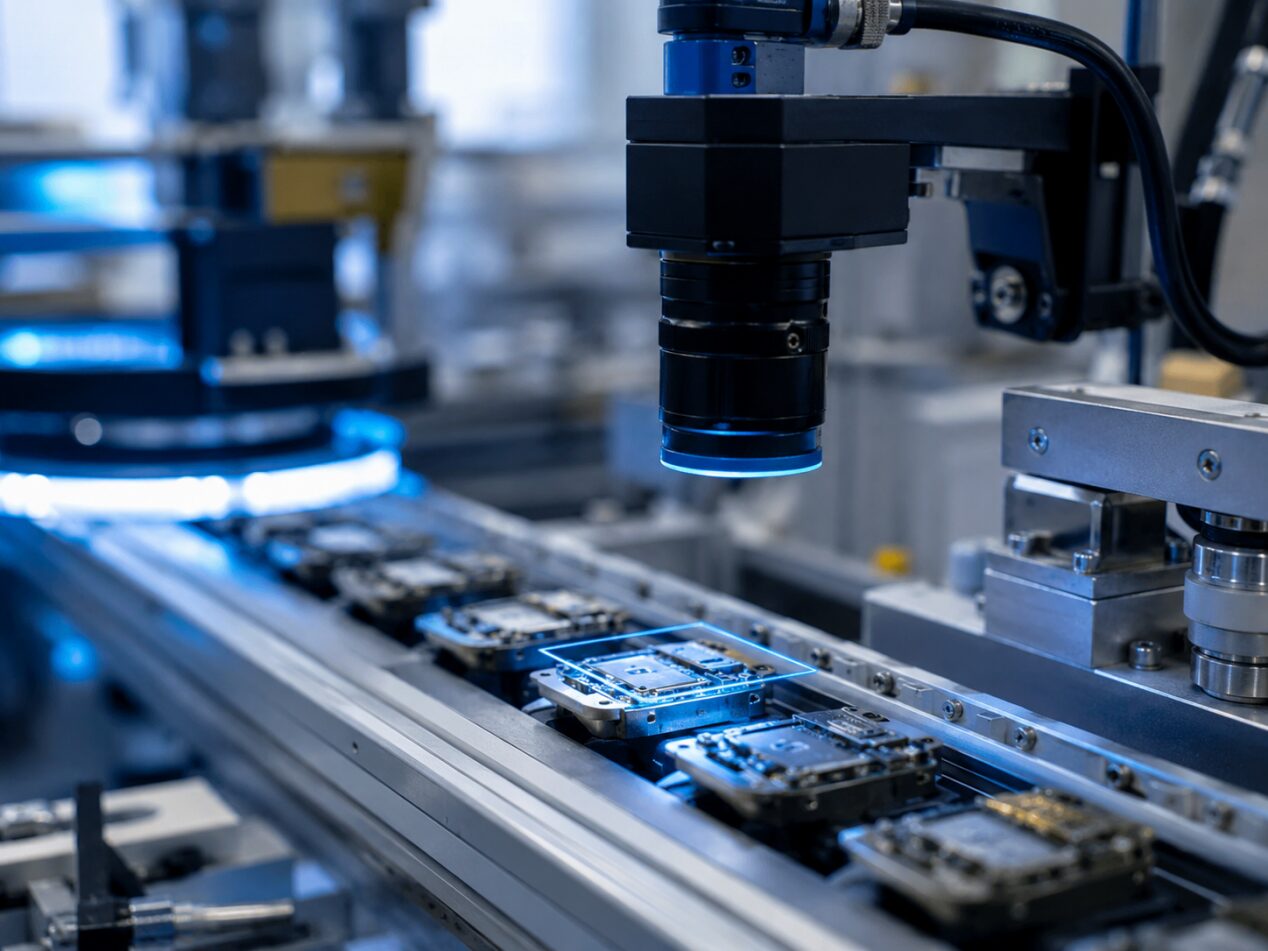
When engineers talk about AI inspection accuracy, they often focus on algorithms and computing power. But many people forget one key point. The camera’s lens decides what the AI actually sees. A good lens can show tiny scratches that the eye cannot catch. A bad lens can make key details blurry. This leads to wrong calls or missed problems. In machine vision systems, clear optics are not optional. They form the base of reliable automation.
Why Lens Choice Matters for Machine Vision Applications
Every lens changes how a camera sees its surroundings. The field of view, depth of field, and magnification all depend on the optical design. Picking the right machine vision lens makes sure the image fits the sensor size and pixel pitch. A mismatch between lens and sensor can cause vignetting or wasted resolution.
Key Optical Parameters That Influence AI Defect Detection
Before looking at focal length or aperture size, remember that each optical parameter works with the others.
Focal Length and Its Impact on Inspection Range
Focal length decides how much of a scene is visible and how clear the details look. Shorter focal lengths such as 2.8 mm give a wide-angle view. They work well for inspecting large surfaces or many parts at once. Longer focal lengths capture finer details from a distance. They also help when space limits how close the camera can be placed.
A practical example comes from a 1/1.8″ 2.8mm 10mp 4K CS mount ultra wide angle industrial vision lens (ACCFA0281610MPCS). With its 2.8 mm focal length and 160° horizontal field of view, this lens works well for wide-area inspections where coverage matters more than extra magnification.
Aperture Size and Light Sensitivity
Aperture controls how much light enters the system. Larger apertures, for instance F1.8, let more light reach the sensor. This improves low-light performance but reduces depth of field. Smaller apertures increase sharpness across different object heights. They do need stronger lighting.
Lenses like 2/3″ 8mm 20mp F4.0 m12 s mount compact machine vision FA board lens (ACHF080402320MP) with an F4.0 iris keep exposure steady in bright factory conditions. They also keep fine detail across several planes. Balancing aperture with exposure time helps AI models get evenly lit images without motion blur or saturation problems.
Distortion Control and Image Uniformity
Distortion adds geometric errors that can confuse AI algorithms during classification tasks. Barrel distortion stretches edges outward. Pincushion distortion squeezes them inward. Both change real-world measurements.
High-quality lenses reduce these effects with multi-element designs and tight alignment tolerances. The ACHF080402320MP keeps TV distortion below -3%. This makes it a good choice for dimensional measurement jobs where accurate geometry matters as much as clarity.
Comparing Lens Types for Machine Vision Applications
Different mounting standards define how lenses fit into camera bodies and automation setups.
M12 Lenses in Compact AI Inspection Systems
M12 (S-mount) lenses stay popular in embedded AI cameras. They combine small size with good optical precision. Their lightweight build fits robotic arms or mobile inspection units where space is tight but high resolution is still needed.
C-Mount vs S-Mount: Choosing the Right Configuration
C-Mount lenses are bigger and support interchangeable optics. High-end industrial cameras often use them when maximum flexibility is needed across projects. S-Mount (M12) options suit integrated designs that focus on cost and small size.
Optical Performance Considerations for AI-Based Defect Detection Systems
Once mounting decisions are set, engineers must make sure optical performance matches sensor capabilities and algorithmic needs.
Resolution Matching Between Sensor and Lens
If a high-resolution sensor pairs with a weak lens, detail is lost before the data reaches the processor. A well-matched pair makes sure every pixel carries useful information.
The ACHF080402320MP embodies this balance, offering 20MP resolution with a 2/3-inch image format, supporting sensors up to 5K resolution without sacrificing edge sharpness. It is suitable for precision defect detection tasks requiring sub-pixel accuracy.
Color Accuracy and Chromatic Aberration Correction
AI models trained on color cues need steady chromatic reproduction across wavelengths. Poor color accuracy can cause false positives during surface checks or material sorting. Multi-element glass structures reduce chromatic aberration by bringing different wavelengths to the same focus point.
Practical Guidelines for Selecting Lenses in Industrial Vision Projects
Choosing a machine vision lens should start with clear application goals instead of browsing specs at random.
Evaluating Application Requirements Before Lens Selection
Ask practical questions first: What defects need detection? How large are the target objects? What is the working distance between camera and subject? These details help decide whether wide coverage or detailed focus is needed.
Lighting conditions also affect the choice. Bright factory floors may work better with smaller apertures like F4. Darker areas may need faster optics such as F1.8 together with IR correction features.
Durability is also important. Operating temperatures of -20°C to +85°C ensure stable performance in various factory environments, preventing focus drift.
Working with AICO
Working with specialized optical providers speeds up integration. It aligns mechanical design with imaging goals instead of treating optics as an afterthought. AICO develops customized M12 and FA board lenses.
These are optimized for AI-driven inspection systems where steady results over thousands of cycles matter more than peak lab numbers. Combining the right optics with modern sensors transforms raw pixels into useful data for automated decision-making systems driven by machine learning algorithms.
FAQs
Q1: What is an M12 lens used for?
An M12 lens is commonly used in compact machine vision systems where space efficiency and moderate resolution are required.
Q2: How does focal length affect AI defect detection?
Short focal lengths cover larger areas while longer ones capture finer details necessary for identifying small defects accurately.
Q3: Why is distortion control important in inspection cameras?
Distortion skews object geometry, potentially confusing AI models trained on precise shapes or dimensions.
Q4: What happens if a low-resolution lens is paired with a high-resolution sensor?
It causes image softness because the optics cannot resolve enough detail per pixel, reducing algorithmic accuracy.
Q5: How do temperature ranges affect machine vision lenses?
Extreme temperatures can shift focus or alter refractive properties; using lenses rated from -20°C to +85°C ensures stable imaging performance year-round.